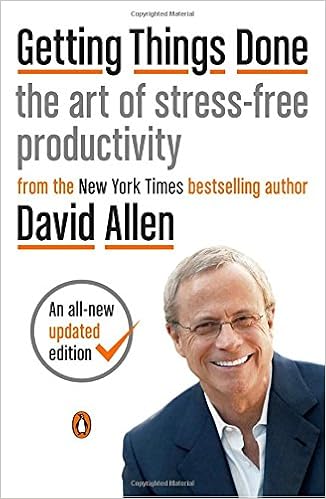
Getting Things Done: The Art of Stress-Free Productivity by David Allen (revised edition, released 2015) (often abbreviated as "GTD") is more than just a description of a way of getting organized to be productive, though it does do that quite well. Beyond that, it offers a helpful recasting of what "work" is as well as a very flexible method to harness readily available tools and resources to make progress on projects we choose as important. GTD can thus be thought of as a lifestyle or a "philosophy" even.
GTD is no isolated "life hack" akin to a more efficient way to change a bicycle tire or mentally multiply numbers. Rather than a technique for optimizing one's approach to some specific task, it is something of a total overhaul of the way many of us (myself included) have thought about work and productivity. Whether one aims to learn to play the ukulele, get an A in Calculus class, find a significant other, write a novel, or accomplish any other sort of complex goals, GTD can be used to make progress on (and ultimately complete, if possible) these projects.
Remembering what we want to, when we want to
Much of Allen's system is built around the idea that simple technology can be used to regain control of our minds, and by extension how we spend our time. Allocating huge amounts of head space to largely unpleasant and unhelpful thoughts seems to be our default mode of operating. Especially when a complex environment relentlessly bombards us with more and more information which flags itself as "urgent" (e.g. app notifications fighting for priority on your smartphone's notification list), we have a tendency to get fixated on things that aren't in line with what we decide we want when we are given some time to think about what is important to us.
For instance, a student's otherwise pleasant Saturday may be plagued by a thought like "read chapter three of textbook by Tuesday". Such a thought is neither especially helpful nor particularly enjoyable. Yet, it may pop up again and again in this student's head, causing him to lose focus when he tries to read for pleasure, enjoy a dinner with the family, win a game of League of Legends, etc. Remembering that chapter three's reading needs to be done by Tuesday neither actually helps get the task of reading done nor makes one smile thinking about. Indeed, as long as this student actually remembers to get this assignment done, even just one reminder is adequate.
Understanding this idea, many people make use of TODO lists, agendas, planners, and the like to make sense of busy schedules. Off-loading the mental strain of remembering a task like this to an "extended mind" in this manner, our student frees up cognitive resources (e.g. attention, working memory) to actually focus on accomplishing that reading when it comes time, to enjoy the weekend, and so forth.
For people with modest goals or those in already highly structured lifestyles, simply listing tasks to do and checking them off my suffice for being organized. In grade school, I pretty much just had to do my homework. Then I was free to do what I wanted, or was made to do something I didn't have much say in. Checking off boxes on lists I created in the planners school gave us was adequate. Things may get harder, however, when we find ourselves in the business of...
"Adulting"
Simple checklists and agendas quickly become less useful in face of more complex lifestyles. Consider the following list, which is not particularly long or complicated:
☐ Read chapter three of textbook by Tuesday
☐ Pay rent
☐ Call back Auntie A
☐ Apply for grant by Jan 29
☐ Meet friends for lunch, B street 1 PM Thursday
☐ Study Japanese
A productive day may start with finishing some items on this list. So far so good:
☐ Read chapter three of textbook by Tuesday
☑ Pay rent
☐ Call back Auntie A
☐ Apply for grant by Jan 29
☑ Meet friends for lunch, B street 1 PM Thursday
☐ Study Japanese
But then, it is 5 PM, the sun is going down and there is still much work to be done. Looking at the list, an inner monologue begins:
What's to be done next? I would like to read chapter three, but I don't have my book with me now (it is in my room, and I'm at Starbucks). I have to call Auntie A, but what am I supposed to say? Oh... that grant to write. I'm still waiting on such-and-such to get back to me. Okay, then I'll study Japanese. Now, I want to work on speaking, but who is there around me to speak with? Maybe I'll go on Facebook to check... hmm...
By this point, my list isn't even helping me. I know I have to read that chapter! I hope Auntie A doesn't call me while I'm asleep like she did last time I didn't call soon enough. Just thinking about that grant makes me tired. Aughhhhhh!!!
One problem with a sort of ad-hoc listing of things and projects like that on the example given here is that the items are of different types and demand different sorts of action. Some items on the list are easily dealt with immediately; for example, paying rent might simply mean dropping off an envelope with a check you already wrote yesterday. But other items on the list are either ill-defined or represent larger projects that can't be "checked off" so easily without some thought and planning.
GTD, among its many other useful functions, provides a system for breaking down more complex projects into simpler tasks. Calling back Auntie A may seem simple enough, but upon closer inspection, there may be many sub-objectives we want to make sure to accomplish before making that call.
- ☐ Call back Auntie A
- ☐ Watch the cute cat video I'm sure Auntie A will talk about
- ☑ Confirm my availability for next week's family gathering
- ☐ Select location for next month's family gathering
Clearly, projects (in the sense of any complex goal we want to carry out) can become overwhelming very quickly. Simple checklists and agendas can be very useful, but if not used effectively (e.g. in such a way that we can reasonably expect to check off check boxes) they quickly lose their utility. This is where GTD comes in...
On a list, out of mind
GTD gives a method for turning complex, or even illusory goals into actionable steps that can populate TODO lists and eventually give that satisfying feeling of accomplishment when it comes time to check off those boxes. Even before it comes time to check off items as "done" though, much of the magic is already happening. This is because the action of formulating a plan to accomplish some goal already does much of the work of regaining mental space. Once we have a concrete plan for something, all the thoughts of "oh, I should do XYZ...", can go away because we have provided ourselves with a resolution.
In this way, doing any complex task (i.e. project) is explicitly split into at least two broad categories of "doing". First, is planning. Second, is carrying out the steps in that plan. While this division may sound simple enough, in practice it is often a distinction we don't make, and end up suffering much as a result of our mistakes. As my middle school art teacher put it, "one minute of planning can save hours of frustration". It seems this idea scales. One hour of project planning can save hours, if not days, weeks, months... on a confused project.
GTD is innovative in that it draws on previous insight (e.g. TODO lists can be very useful for keeping track of things to be done) and gives a framework in which these relatively simple skills can be used in even very complex workflows.
Wrap-up
I first became acquainted with GTD
scrolling down Facebook and seeing an
article, which is fitting place to get interested in such a system because at that moment, I wasn't getting much of anything done. Some weeks after having read about GTD, I did the 21st century consumer-reader thing to do and bought the Kindle edition of GTD. It wasn't until months later that I actually took the time to read Allen's book. I am very glad I took the time to do so! Admittedly, I have only read GTD once, though I have spent many hours thinking about many of the ideas in that volume. I do, in any case, plan to read it again. Writing this post has likewise motivated me to revisit GTD.
Currently, I implement a version of GDT digitally using Org mode with emacs. While I am a fan of emacs, I realize that it can also be a great source of frustration for those that aren't interested in wrestling with software. Fortunately, more intuitive solutions exist.
Trello is another great piece of software, particularly for collaboration. I think it can work especially nicely with GTD because, among other reasons, it only uses a small number of relatively simple (conceptually) building blocks that can be used and reused flexibly to fit your particular work style.
Labels: books, cognitive artifacts, memory, psychology, workflow